

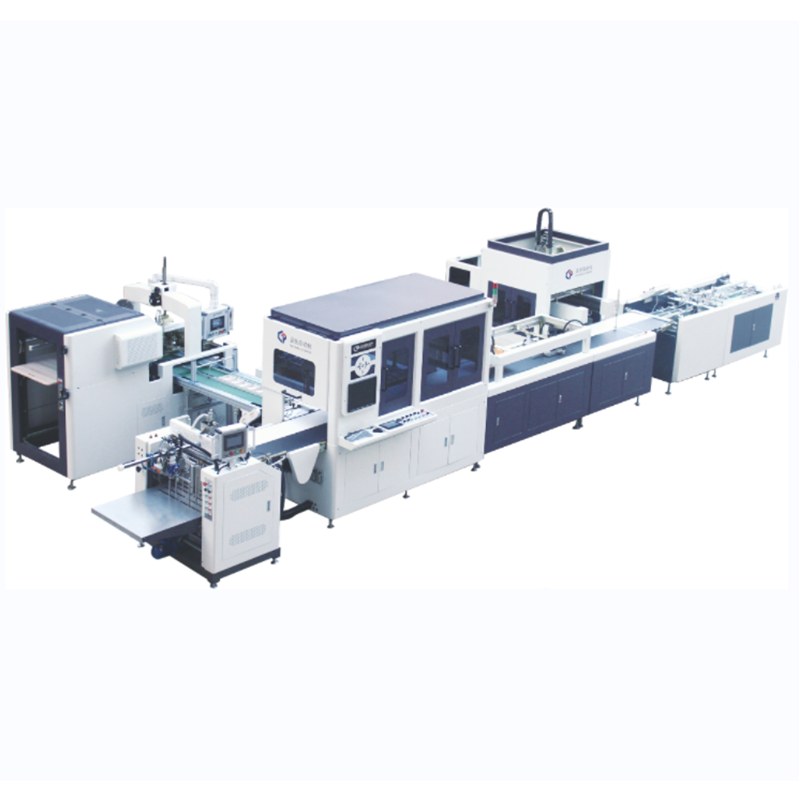
A gift box making machine has to do something that ordinary production equipment is not designed for: survive a peak season. Gift and seasonal packaging arrives as a wave of similar but not identical products, with deadlines fixed by a calendar that cannot be moved, and the machine that wins that work is usually the one that changes size fastest rather than the one with the highest top speed.
At Pinchuang, we have been manufacturing rigid box equipment in Dongguan since 2008, and we spend most of the autumn talking to customers about exactly this problem. This guide sets out what gift packaging actually demands from equipment, why changeover beats peak speed, what a gift box workshop's machine list looks like, and how to plan capacity so that a peak season does not turn into a quality problem.
What Gift and Seasonal Packaging Demands From a Gift Box Making Machine
Gift packaging is not the same business as mainstream packaging, and the difference shows up in four ways.
- Runs are medium rather than long. A seasonal order might be a few thousand boxes in one size, which is long enough to justify a machine setup and short enough that the setup is a meaningful share of the total time.
- Sizes cluster but do not repeat. A gift range might use eight sizes across a season, each used for a limited period. The machine has to move between them repeatedly without losing its settings.
- The wrap carries the value. Gift packaging is bought for its appearance. Textured papers, foils, printed patterns and special finishes are normal rather than exotic, and each one behaves differently on the machine.
- The deadline is fixed by the calendar. A retail season has a date attached to it. Late output cannot be sold later at a discount, because the season is over.
Together these four points push the equipment decision away from raw speed and towards flexibility and repeatability. That is a different specification from the one a plant buying for year-round volume would write.
Changeover Speed Matters More Than Peak Speed
Ask two suppliers about their machines and both will quote a top speed. Ask either what a size change takes, and the conversation becomes vaguer. For gift packaging that second number is the one that decides the season.
The arithmetic is simple. If a machine runs at 40 boxes a minute but loses most of a shift to a changeover, and a slower machine at 25 a minute changes over in a fraction of the time, the slower machine will finish more orders in a peak week. Over a season of eight sizes and twenty orders, the gap compounds.
| What to compare | Why it matters in a peak season |
|---|---|
| Actual changeover time on your own box | Determines how many orders you can fit into the season, not how fast one order runs |
| Whether settings can be recorded and restored | A size you ran in October should not be a new setup when it returns in December |
| Tooling prepared in advance | Moulds and jigs made during the quiet period remove hours from the peak |
| How the machine behaves on seasonal wraps | Foil, texture and laminate all change glue and forming behaviour |
The practical test is to ask a supplier to change the machine over in front of you, using two of your own box sizes. Any supplier confident in their equipment will do it. The answer you are looking for is not a number in minutes but the number of adjustments that have to be made by feel rather than by a reference.
The Equipment Set for a Gift Box Workshop
A gift box line is a sequence of stations rather than one machine, and each one can be added as the bottleneck moves.
- Grooving. A V grooving machine cuts the fold channels. On gift work this is where the wrap gets its sharp, premium edges, and a shallow groove is the fastest way to make an expensive box look cheap.
- Gluing. A paper gluing machine applies the film. Seasonal wraps are usually heavier and more textured than standard ones, so glue settings change with every range.
- Positioning. A visual positioning machine reads printed marks and corrects position. When a design has to sit centred on a lid, mechanical stops alone will not hold it across a season of different wraps.
- Corner pasting. A corner pasting station tapes the four flaps. Gift boxes are handled heavily in shops, so corner strength matters more here than in most other packaging.
- Forming. A rigid box forming machine presses the wrapped panel into the finished box. This is the station most buyers ask to see running before they commit.
You do not need all five to start. A plant moving off the bench usually adds gluing and forming first, then corner pasting, then grooving, and visual positioning last if the work demands it. The important thing is to buy the first machine with the final line in mind, so that the stations added later match rather than duplicate.
Planning Capacity Around a Peak Season
Peak seasons are predictable, which is both the problem and the opportunity. The capacity you need in December has to be decided in June.
Three practices make the difference between a peak season that runs smoothly and one that produces rejects.
- Build tooling in advance. Every new size in the season needs a mould or a jig. Making them during the quiet period turns a two-day changeover into a two-hour one. This is the single highest-return preparation any gift box workshop can do.
- Run samples on the actual seasonal wraps. A box that forms perfectly in plain paper may wrinkle in a textured or foiled wrap. Confirming the wrap before the order is released costs a day; discovering it in the middle of the run costs the season.
- Plan the order sequence, not just the total. Grouping sizes so that similar work runs together reduces the number of changeovers. A plant that sequences orders well can produce noticeably more from the same machine than one that takes them in the order they were sold.
None of this requires new equipment. It requires treating the peak as a production plan rather than as a period of emergency, and it is the advice we give most often when customers ask whether they need a second machine before a busy season.
Two Configurations That Suit Gift Production
On our rigid box platform, the two machines most gift box producers compare cover the same box range from 65 × 65 × 15 mm up to 500 × 400 × 120 mm, and differ in how they are arranged.
| Parameter | PC-5040A | PC-5040B |
|---|---|---|
| Production speed | 26–40 pcs/min | 16–25 pcs/min |
| Configuration | High speed, two-piece box forming | Corner pasting, forming and positioning combined |
| Machine dimensions | L 8200 × W 6000 × H 2150 mm | L 8200 × W 4200 × H 2150 mm |
| Best fit for | High seasonal volume on a stable size range | Mixed gift ranges and a shorter footprint |
For a gift workshop, the practical difference is footprint and throughput. The B configuration occupies two metres less width, which matters in a plant already full of material, and it brings positioning into the same frame. The A configuration is the right answer when the season is genuinely large and the size range is settled. When the boxes themselves are small — jewellery and cosmetics packs, slim gift sets — the compact PC-350A covers sizes from 45 × 45 mm upwards in roughly half the floor area.
For scale reference, Pinchuang builds this equipment in a 10,000 m² facility in Dongguan with more than 100 employees, and the machines ship to over 30 countries. We have been manufacturing rigid box equipment since 2008, and we exhibit at All in Print China, Printing South China, China Print, Drupa, SINO FOLDING CARTON and WEPACK.


Gift box work is one of the clearest applications for rigid box equipment, and the reason is simple: the box is the product. Looking at the applications we see most often is the quickest way to check whether the boxes you are being asked to quote look like the ones these lines are built for.
Common Questions About Gift Box Equipment
How many sizes can one gift box line handle in a season?
There is no fixed limit, but each size needs its own tooling and setting record. A workshop that runs eight to ten sizes in a season needs eight to ten sets of forming moulds prepared in advance. Without them, the changeover time per size becomes the limiting factor rather than the machine's speed.
Do I need a second machine before the peak?
Usually the answer is no, and the money is better spent on tooling and sequencing. A second machine only makes sense when the first one is genuinely loaded for a sustained period, not when the work arrives in a short burst that better planning could absorb.
Why do seasonal wraps cause more problems than standard ones?
Texture, foil and laminate change how paper takes glue and how it behaves when it is turned in. Settings that suit a plain 120 g/m² wrap will not automatically suit a textured 200 g/m² one, and a laminated wrap does not absorb adhesive at all in the same way. Treat every seasonal wrap as a new material and confirm it on a sample box.
Can I run gift boxes and standard packaging on the same line?
Yes, and most plants do. The constraint is not the machine but the setting discipline: gift work uses heavier and more decorative materials, so each product needs its own recorded setup. A line is only flexible if the settings are documented well enough to return to.
Send Pinchuang your gift box size list, seasonal volumes and a sample of each wrap you plan to use. We will tell you which gift box making machine fits the range, and how much tooling you should prepare before the season starts.
Send us your size list Compare all box making models